
What happens when science and the guru disagree?
Nov 29, 2026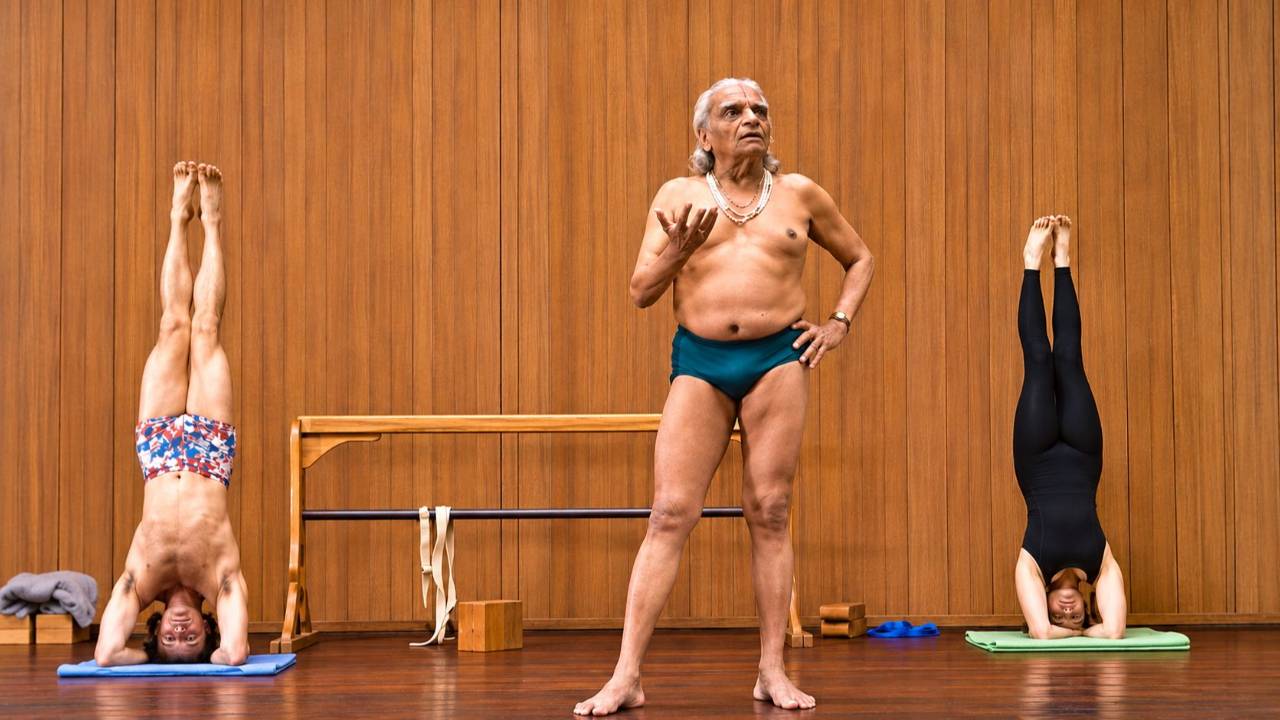
B. K. S. Iyengar’s contributions to modern yoga are immense. His extraordinary powers of observation, his innovations in teaching, and his lifelong exploration of the possibilities of human movement have influenced generations of practitioners. The community he inspired continues to make important contributions to yoga education.
I have great respect for that legacy, as did my teacher, T.K.V. Desikachar, who was Iyengar 's nephew (B.K.S. Iyengar's older sister, Namagiriamma, was Krishnamacharya's wife).
And, there is a question I've had for years, which is addressed to the many physicians, scientists, and other medically trained professionals who studied directly with Iyengar:
What was your reaction when you witnessed your teacher making demonstrably incorrect statements about human anatomy and physiology? And, did you or anyone else ever challenge Iyengar when he did so?
For example, I recently came across the video below, from 1992, in which Iyengar is lecturing on inversions. From the stage, upon which his students are demonstrating headstands, he claimed that venous blood is purified by being directed toward the brain, equated iḍā and piṅgalā with the parasympathetic and sympathetic nervous systems, and asserted that Patañjali’s four categories of samādhi correspond to four regions of the brain.
These weren’t simply unconventional interpretations. They were unsupported physiological claims, some involving fundamental misunderstandings of how the human body works.
I want to distinguish such claims from the imaginative anatomical language yoga teachers sometimes use to direct attention and movement. Telling a student to “breathe into your kidneys,” for example, can be a perfectly useful instruction for exploring movement in the posterior lower rib cage. Nobody needs to believe that air actually enters the kidneys for that instruction to work.
But when a teacher claims to explain how the nervous system, circulation, or brain actually functions, we’re no longer dealing with metaphor or experiential instruction. We’re dealing with propositions that can be evaluated against established scientific knowledge.
And Iyengar frequently and confidently ventured into that territory.
In a fascinating 1990 interview with Margot Kitchen, Iyengar discussed his collaborations with physicians, including Dr. S. V. Karandikar, and expressed considerable confidence in the medical benefits of his methods. Yet when asked about scientific recognition of yoga, he complained that scientists were constrained by their own dogma and expected yogic experience to conform to it.
The interview is especially interesting because Iyengar clearly valued scientific validation while simultaneously expressing frustration with scientific skepticism.
Historian Suzanne Newcombe explores this relationship in her research, Yoga in Britain: Stretching Spirituality and Educating Yogis. She documents Iyengar’s longstanding collaborations with physicians, his encouragement of biomedical investigation, and his willingness to have aspects of his own physiology tested.
All of which makes me even more curious about what happened when a medically trained student disagreed with one of his explanations. So, I have questions.
If anyone ever challenged him, how did he respond? Was he curious and receptive? Did he reconsider his claims, or did he defend them by appealing to traditional authority or personal experience?
If his errors were recognized but no one chose not to challenge him, why not? Were his physiological explanations considered to be incidental to the practical value of his teaching? Was there something about his authority, or the culture surrounding him, that made such conversations difficult?
I’m genuinely interested in firsthand accounts, including examples of Iyengar welcoming correction. I haven’t found a documented exchange that answers these questions, but I don’t want to assume that such conversations never occurred.
There is a fascinating contrast between the extraordinary precision, observation, and discrimination Iyengar cultivated in asana practice and the lack of those same qualities in some of his scientific explanations. His practical accomplishments absolutely deserve recognition on their own terms, without requiring acceptance of his explanations of physiological mechanisms.
A Long History of Extraordinary Claims
To be fair to B.K.S. Iyengar, was hardly the first yogi to make extravagant claims about the health benefits of practice. The Śvetāśvatara Upaniṣad, dating from the last several centuries BCE, associates yogic attainment with freedom from disease, aging, and death. By the medieval period, Haṭha Yoga texts were attributing specific cures to specific practices. The 15th-century Haṭhapradīpikā, for example, credits Mayūrāsana with overcoming abdominal diseases and even the effects of poison, while Mahāmudrā supposedly eliminates consumption and leprosy. As yoga historian Jason Birch documents in Premodern Yoga Traditions and Ayurveda, sweeping therapeutic promises were commonplace in premodern yoga literature.
These claims persisted well into the twentieth century. In his 1934 Yoga Makaranda, Iyengar’s own teacher, T. Krishnamacharya, credited Jānu Śīrṣāsana with eliminating diabetes and early symptoms of tuberculosis, Maṇḍūka Mudrā with preventing aging and greying hair, and Mayūrāsana with protecting the practitioner against every disease. He even claimed that the practice of twenty mudrās could prevent 84,000 diseases. Iyengar, therefore, inherited these kinds of therapeutic claims not only from centuries of yoga literature but from the teachings of his own guru.
What distinguishes the era in which Krishnamacharya and Iyengar developed their teachings is the extraordinary convergence of scientific, political, and spiritual influences. During the late 19th and early 20th centuries, Indian reformers were reclaiming yoga as a source of national and cultural pride, Western audiences were becoming increasingly interested in Indian spirituality, and pioneers such as Swami Kuvalayananda and Shri Yogendra were attempting to establish yoga’s physiological effects through scientific investigation. Traditional concepts were increasingly being interpreted through the language of modern anatomy and medicine. This history is explored in Mark Singleton’s Yoga Body and the scholarship surrounding the emergence of modern postural yoga.
Iyengar emerged as one of the most influential figures in this changing landscape, bringing an inherited tradition of extraordinary therapeutic promises to an international audience increasingly receptive to scientific explanations.
The problem was not that Iyengar sought to understand yoga through modern physiology. It was that he so often presented speculative, confused, or demonstrably incorrect explanations as established scientific fact.
The therapeutic promises were centuries old. The scientific vocabulary was new. What remained missing was the evidence connecting them.
In his essay Yoga Is Not a Science, Bernie Clark distinguishes the value of yoga practice from the scientific validity of explanations offered for its effects, specifically questioning the unsupported therapeutic claims Iyengar made in Light on Yoga. His point is worth emphasizing: Yoga doesn’t have to be a science to be valuable, but invoking science to explain yoga carries an obligation to get the science right.
I believe we can honor Iyengar’s achievements, appreciate the contributions of his students, and still examine his mistakes without defensiveness. In fact, doing so seems entirely consistent with the spirit of inquiry that made his teaching so influential.
I am well aware that this topic is likely to ruffle a few feathers, so please know that I am truly open to hearing from any students of Iyengar on this issue, as long as the exchange is civil.
Stay connected with news and updates
Join our mailing list to receive news and updates from Leslie.
Don't worry, your information will not be shared.
We hate SPAM. We will never sell your information, for any reason.