
In 1988, I took my first, calamitous top-to-bottom inhale
Nov 07, 2026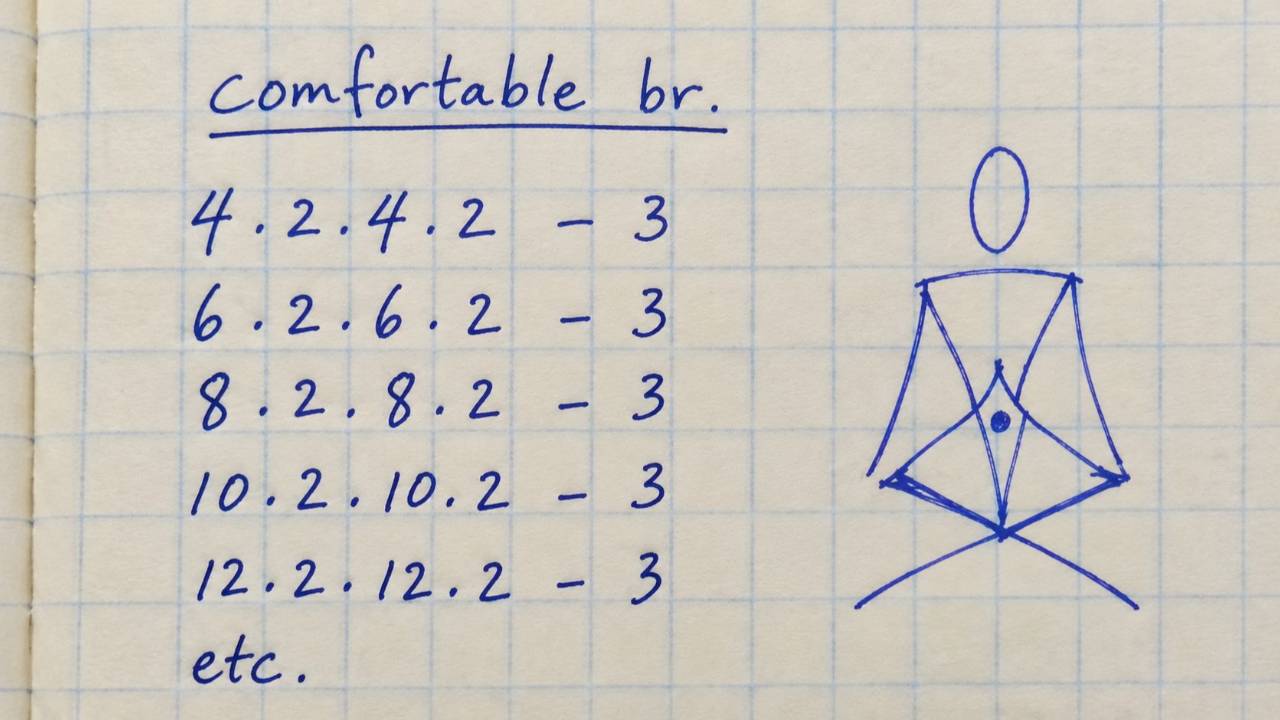
The setup
In 1988, after nine years of teaching yoga, I attended my first seminar with T.K.V. Desikachar. I was 29 years old, knew quite a bit about breathing (or so I thought), and had developed considerable confidence in the methods I’d been practicing and teaching. Then, during a morning pranayama session, one of Desikachar’s senior students gave us a simple exercise that included an instruction I found completely unacceptable: inhale from the top of the chest downward, reversing the three-part breathing pattern I’d learned years earlier.
I decided to follow the timing instructions for the breath ratios while continuing to breathe my own bottom-to-top way. After all, I was already pretty good at this stuff. But as the breaths grew progressively longer, my determination to outperform everyone else in the room began colliding with the instructor’s other requirement: remain comfortable. Eventually, exhausted, trembling, and engaged in a rather intense internal argument, I reluctantly decided to try the top-to-bottom technique I’d been resisting.
What happened next was the most extraordinary—and disruptive—experience of my yoga career. It challenged everything I thought I knew about breathing, triggered a physical sensation that persisted for six months, and ultimately changed the direction of my teaching. In this 10-minute video excerpt from one of my courses, I tell the story, including some of the less dignified thoughts running through my head that morning. It’s also the story of how I began to understand the diaphragm in an entirely new way.
The story
I’ve often used the following analogy to explain what it felt like happened to me during that extraordinary inhalation.
Imagine a large electric fan that’s been running in the same direction for years. Everything in the room has adapted to the breeze it produces. The curtains blow a certain way, dust settles in particular places, the plants grow in a certain direction, and the entire environment has organized itself around that one consistent direction of airflow.
Now imagine that the fan is powered by a conventional DC motor. If you disconnect the electrical leads while the blades are still spinning, reverse their polarity, and reconnect them, the current flowing in the opposite direction through the motor suddenly produces torque in the reverse direction. But the blades don’t immediately reverse. They still have all the rotational inertia of spinning the other way, so the motor has to fight that momentum before it can bring the blades to a stop and slowly start them turning in the opposite direction. This can produce enormous electrical and mechanical stress, potentially overheating or even burning out the motor.
That’s about as close as I can come to describing what happened to my system in 1988. For almost a decade, I’d been practicing and teaching a bottom-to-top breathing pattern until it had become completely automatic. My nervous system had learned to coordinate the muscular activity of breathing in a particular sequence, and I no longer needed to think about it. Then, in the space of a single inhalation, I introduced a fundamentally opposite pattern. It was as though I’d reversed the polarity of the motor while the fan was still spinning at full speed.
But there was another source of inertia that had nothing to do with my respiratory muscles. I’d spent many years building a professional identity around being someone who understood breathing. I’d developed methods, taught students, and established a reputation based on knowing what I was doing regarding breath. I had a considerable emotional, professional, and reputational investment in being right about this stuff. As difficult as it would prove to be, changing my breathing habits was a far easier task than accepting the fact that I might have not understood something so fundamental about breath.
So when I describe that moment as having blown a fuse, I’m not suggesting that my nervous system literally experienced an electrical short circuit. It’s an analogy for the collision between a deeply established motor habit and an unfamiliar way of organizing the same activity, compounded by the emotional upheaval of having my professional identity thoroughly deconstructed.
Of course, an actual motor subjected to that kind of sudden reversal would probably just burst into flames. Although my body did not spontaneously combust, it did take about six months to feel like it could breathe fully again. Through that transition, all my system was really trying to do was take that last bit of breath that it couldn't quite reach at the end of that first, unprecedented inhale during that seminar with Desikachar.
The task that remained...the task that still remains...is understanding as much as I can about the underlying mechanism of breathing and finding better ways to share what I've discovered.
If you have received value from my writing, please consider supporting it by subscribing to my online community. You will gain access to my online courses, monthly Q&A Zoom chats, and hundreds of hours of educational content.
Stay connected with news and updates
Join our mailing list to receive news and updates from Leslie.
Don't worry, your information will not be shared.
We hate SPAM. We will never sell your information, for any reason.