
Why You Really Don’t Want to Breathe Like a Baby (Part 2 - the technical stuff)
Oct 07, 2026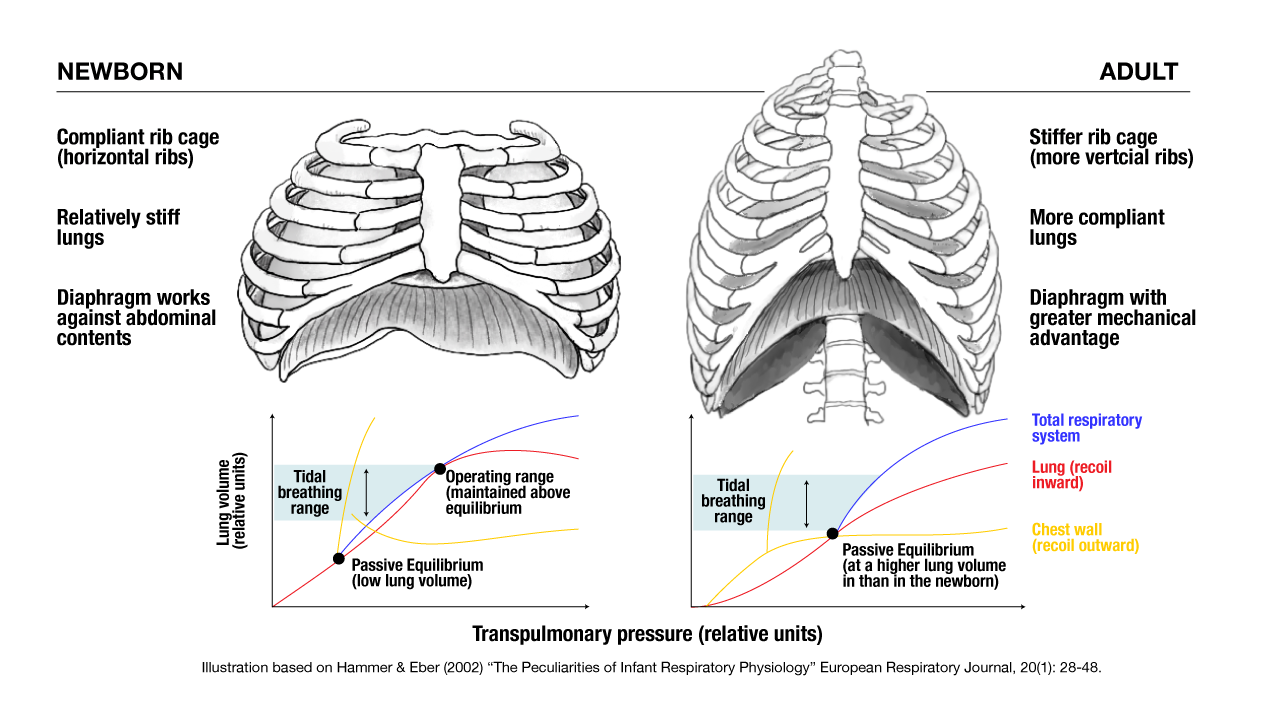
In Part 1, I argued that babies are poor breathing models for adults because their respiratory systems are solving fundamentally different mechanical problems compared to adults. If you haven’t read it yet, I recommend starting there. Now, I want to look more closely at the developmental physiology behind that argument—and at how it supports a conclusion I originally came to from a very different direction.
How I came to think about this
I’ve been making some version of the “babies are bad breathing role models” argument for more than twenty years. I originally arrived at it through functional anatomy rather than pediatric respiratory physiology.
In January 2005, I published “The Case for the 3-D Diaphragm,” challenging an idea already deeply entrenched in yoga and breath education: belly movement is good, chest movement is bad; belly breathing is diaphragmatic, chest breathing isn’t. Later that year, while developing material that eventually became part of Yoga Anatomy, I connected the issue explicitly to babies. In a footnote to my article “What Yoga Therapists Should Know About the Anatomy of Breathing,” I wrote: “This also explains why babies’ breath goes everywhere: they aren’t standing up yet!”
My point then was primarily about posture and gravity. A baby lying on its back doesn’t need to organize the muscles of the abdomen, spine and rib cage for the same tasks required of someone standing upright. Eventually, that point became explicit in our YogaAnatomy.net Fundamentals curriculum: “We cannot use babies as a model of what works for us as adults.”
What I had arrived at through functional anatomy and observation turns out to have a much deeper developmental and physiological basis.
The peculiar physiology of infant breathing
Also in 2005, pediatric pulmonologists Jürg Hammer and Ernst Eber summarized many of the relevant differences in a chapter called “The Peculiarities of Infant Respiratory Physiology,” published in Paediatric Pulmonary Function Testing. It contained this very handy chart:
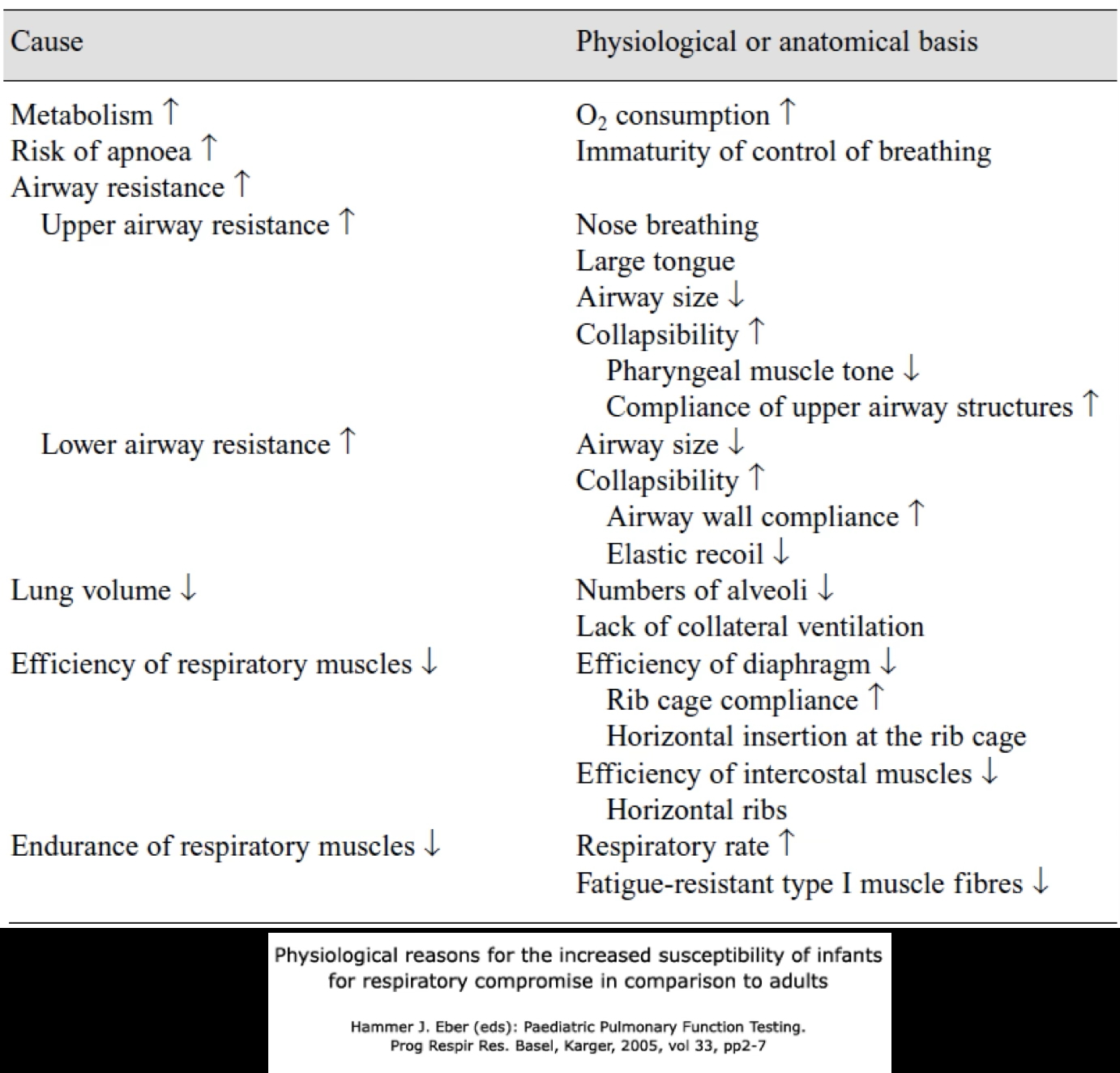
What the chart is visually demonstrating is that, compared with adults, infants have:
* higher oxygen consumption relative to their size
* smaller and more collapsible airways
* greater airway resistance
* lower lung volumes
* much more compliant rib cages
* more horizontally oriented ribs
* less efficient respiratory muscles
* fewer fatigue-resistant muscle fibers.
Taken together, all of this creates a respiratory system that has to work considerably harder than an adult’s simply to maintain adequate ventilation.
Keeping the lungs open
The central mechanical problem begins with the relationship between the lungs and the chest wall.
Lungs naturally recoil inward, while the chest wall exerts an opposing force. In a healthy adult at the end of an ordinary expiration, those forces reach an equilibrium that leaves a useful residual volume of air in the lungs.
An infant starts with a very different arrangement. The stiffer lungs exert considerable inward recoil, while the highly compliant chest wall provides relatively little opposing force. If the system were allowed to settle entirely into its passive mechanical equilibrium, the infant’s end-expiratory lung volume would be lower than is useful, so infants don’t simply allow that to happen by actively maintaining lung volume above its passive equilibrium. Rapid breathing begins the next inspiration before expiration has completely run its course. Partial closure of the larynx during expiration creates resistance to outgoing airflow, and diaphragmatic activity can continue into expiration rather than simply switching off at the end of inspiration.
This is a crucial difference from the familiar picture of relaxed breathing in which inspiration requires muscular activity and expiration occurs largely through passive recoil. The infant is actively managing airflow and lung volume during both phases of the respiratory cycle.
The very breathing behaviors that would look abnormal if you tried to reproduce them as a healthy adult are part of the infant’s solution to the mechanical problem of being an infant.
What the diaphragm is up against
The highly compliant infant rib cage creates another problem.
In an adult, the relatively stable lower ribs can provide an attachment from which the diaphragm generates both downward displacement and a lifting action that expands the lower rib cage. The infant chest wall provides much less structural stability. As a result, diaphragmatic contraction can actually deform the chest wall inward during inspiration, particularly as respiratory demands increase.
This adds an important piece to the visible “belly breathing” discussed in Part 1. What we see externally isn’t evidence that the infant diaphragm is functioning in some purer or more efficient fashion. In fact, the opposite is closer to the truth: the diaphragm is working within a mechanically disadvantaged system and doing what it can with the structure available to it, and it has to do that job in an organism with unusually high metabolic demands.
Breathing is expensive when you’re a baby
Infants consume substantially more oxygen per kilogram of body weight than adults. They therefore need to move more air relative to their size, through smaller airways with greater resistance.
At the same time, their respiratory muscles have less endurance. The infant diaphragm contains a smaller proportion of fatigue-resistant type I muscle fibers than the mature adult diaphragm, while the geometry of the rib cage makes both diaphragmatic and intercostal muscle action less mechanically efficient.
Put those facts together and infant breathing begins to look very different from the image that gave rise to the “watch a baby breathe” cliché. The rapid respiratory rate, incomplete expiration, expiratory braking and continued diaphragmatic activity are far from signs of effortless breathing. They are an integrated strategy for meeting a relatively high metabolic demand with an immature respiratory apparatus.
Growing out of it is the point
As a child develops, the relationship among all these structures changes. The lungs become more compliant, the chest wall becomes stiffer, the airways enlarge and stabilize, and the respiratory muscles become stronger, more efficient and more resistant to fatigue.
At the same time, something else happens that was central to my original thinking about this twenty years ago: the child gets up and starts sitting, standing, walking and running. All these activities require the muscles surrounding the abdomen, spine and rib cage to participate in postural support and movement. Breathing becomes integrated with an increasingly upright body that is in continual dialogue with gravity. The same structures that participate in respiration now have many other jobs to do. That isn’t a departure from natural breathing. It is natural breathing.
This brings me back to why I became interested in the myths surrounding how babies breathe in the first place. The mistake isn’t confined to believing that babies use their diaphragms correctly while adults forget how to breathe naturally. These kinds of errors arise when we long for a single, visible, simplistic ideal that can serve as a model for what is “correct” regardless of age, posture, activity or circumstance. Living systems just don’t work that way. They grow, evolve, and adapt.
There is a lot we can learn from babies, but it would be a mistake to turn any developmentally specific pattern into an anatomical, kinesiological or physiological ideal. The goal isn’t to breathe like a baby. It’s to have the freedom and resilience to breathe appropriately for who we are now, whatever we’re doing in the moment.
If you have received value from my writing, please consider supporting it by subscribing to my online community. You will gain access to my online courses, monthly Q&A Zoom chats, and hundreds of hours of educational content.
Stay connected with news and updates
Join our mailing list to receive news and updates from Leslie.
Don't worry, your information will not be shared.
We hate SPAM. We will never sell your information, for any reason.