
Is 3-part breathing a yogic technique with pre-modern roots?
Oct 24, 2026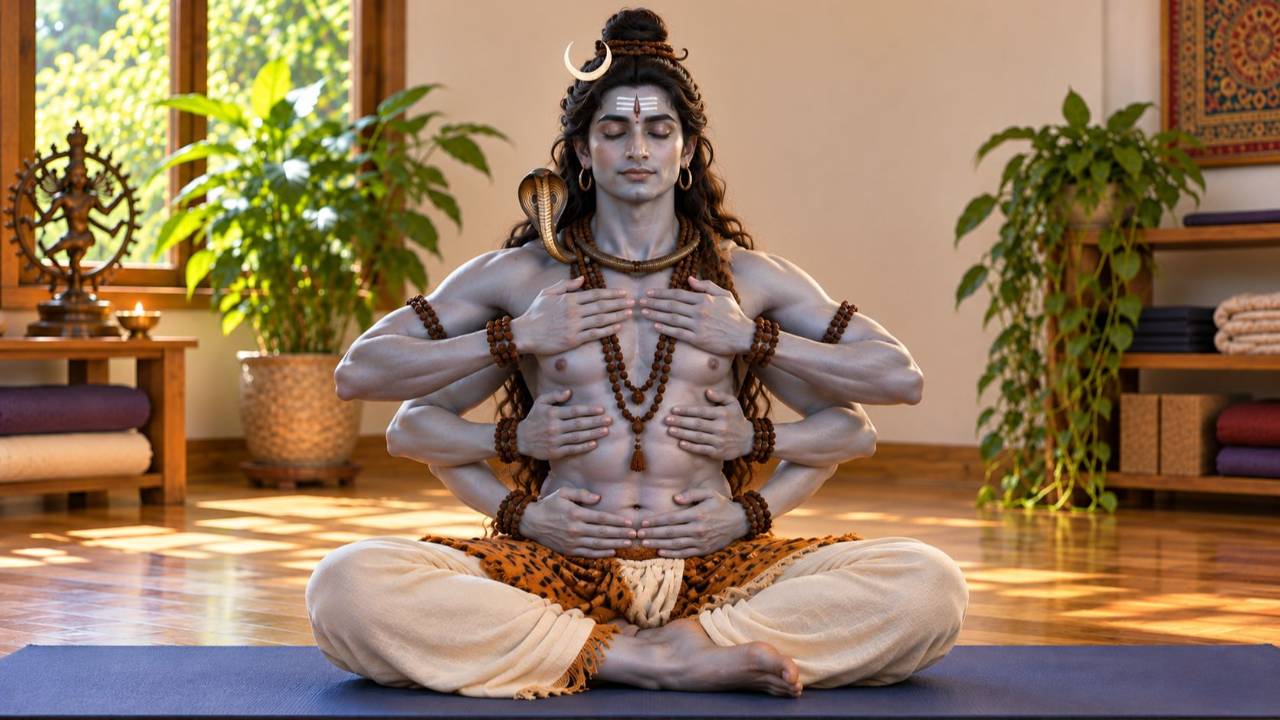
As far as I can determine, the answer is no.
Three-part breathing—variously called the “full yogic breath,” “complete breath,” dirgha pranayama or dirgha swasam—is now so thoroughly embedded in modern yoga that its Indian origins are rarely questioned. The familiar instruction is to inhale progressively into the abdomen, expand the lower and middle ribs, and finally fill the upper chest, then reverse or otherwise coordinate those movements during exhalation.
Traditional Indian yoga certainly contains extensive teachings about breath. Premodern texts describe puraka (inhalation), recaka (exhalation), kumbhaka (retention), nostril control, breathing ratios, bandhas and numerous named pranayama practices. Patanjali famously describes the breath becoming dirgha—long—and sukshma—subtle (Yoga Sūtra 2.50). But that isn’t three-part breathing.
So far, I have found no premodern Indian yoga text that divides breathing into abdominal or diaphragmatic, costal or rib-cage, and upper-chest or clavicular components and then instructs the practitioner to combine those three regions into a complete breath. More importantly, scholars who have investigated the development of modern pranayama have not identified such a source either. What we can document is something rather different.
Before the “Yogi Complete Breath”
By the middle of the nineteenth century, European physicians and voice teachers were intensely interested in respiratory mechanics. French physician Louis Mandl was writing about breathing and vocal function in the 1850s. Subsequent European singing and voice-training literature increasingly distinguished among abdominal or diaphragmatic, lateral or costal, and clavicular breathing.
An important early example comes from the German voice teacher Oskar Guttmann, who, as early as 1867, distinguished three forms of breathing: abdominal or diaphragmatic, side or rib, and shoulder or collarbone. Guttmann identified three observable patterns of breathing, but that's not the same as prescribing the sequence in which they must occur.
By 1890, the influential Italian singing teacher Francesco Lamperti was discussing essentially the same three anatomical modes of respiration. Then, in 1891, American physical-culture teacher, vegetarian and anti-corset activist Carrica Le Favre published Delsartean Physical Culture. In it appears a sequential exercise with a particularly interesting name:
“The Full Breath.”
Le Favre instructs the student to begin by filling the lower lungs, continue into the middle lungs, and finally fill the upper lungs near the clavicles. Exhalation proceeds back through the regions.
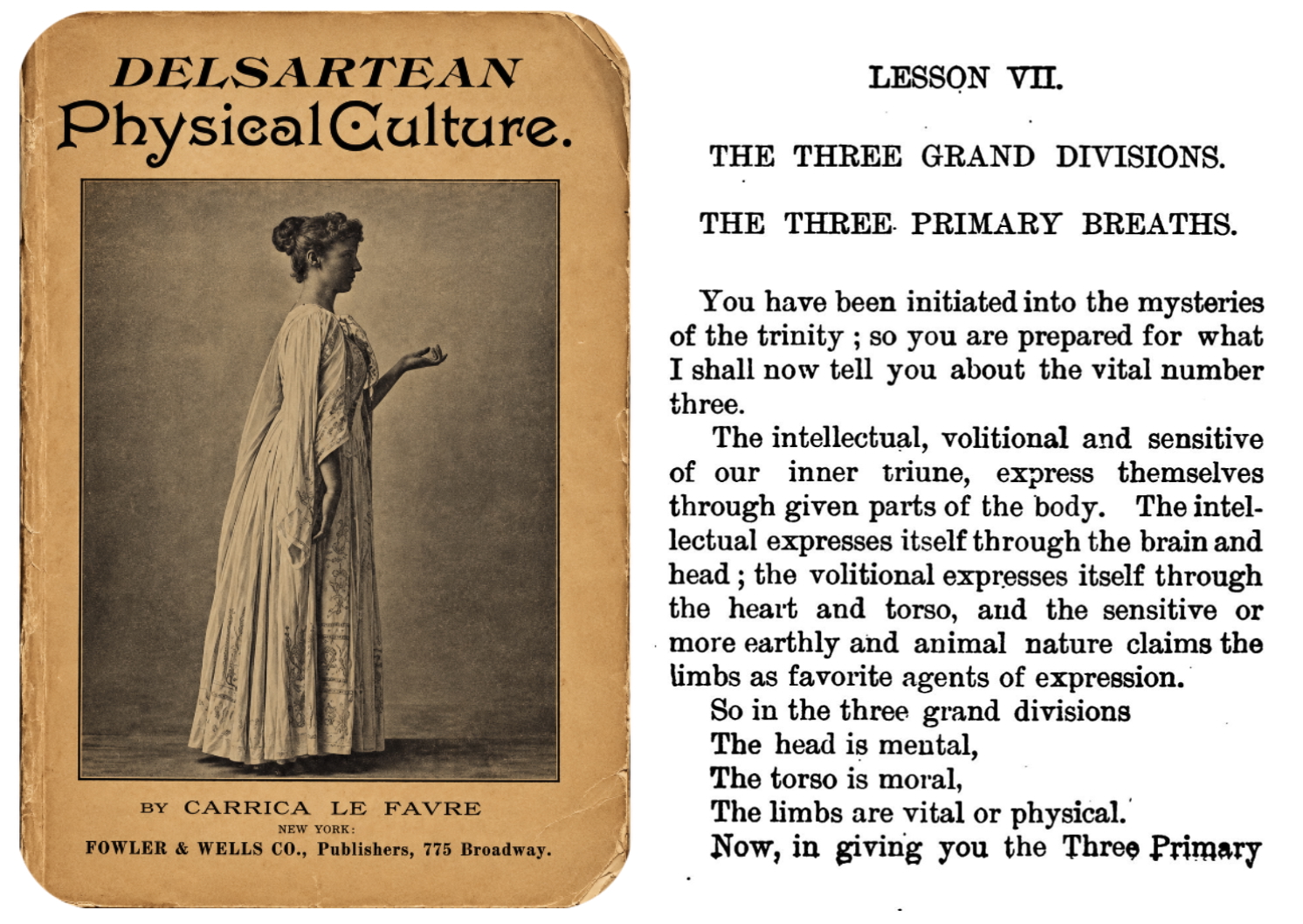
In other words, twelve years before anyone called this a yogic technique, an American physical-culture teacher was already teaching an explicitly sequential three-part “Full Breath.” She was also assigning specific psychic qualities to the three regions:
"Breath at the top of the lungs, called CLAVICULAR breath, is decidedly mental in its action and effects. The COSTAL breath is moral in its action and influence. The ABDOMINAL breath is physical in its action and effect. It will be well for you to further understand that :The CLAVICULAR breath is directing, The COSTAL breath is impelling,The DEEP breath is sustaining."
Le Favre was part of the American Delsartean movement, which adapted the teachings of French voice and drama instructor François Delsarte (1811–1871) into a popular system of physical culture emphasizing posture, movement, breathing, and relaxation. Like Catharine Beecher, its proponents often advocated women’s physical education and dress reform. Although Delsarte himself may never have taught three-part breathing, his American followers helped popularize the Western breathing practices that would soon be presented as ancient yogic wisdom.
And then along came "Yogi Ramacharaka."
In 1903, a book titled The Hindu-Yogi Science of Breath appeared under the name “Yogi Ramacharaka.”
There was no Yogi Ramacharaka. The author was William Walker Atkinson, an American lawyer, publisher and prolific New Thought and occult writer who produced books under numerous pseudonyms and personas.
Atkinson divided breathing into “Low Breathing,” “Mid Breathing” and “High Breathing.” He then combined their desirable features into what he called the “Yogi Complete Breath.”
The resemblance to the Western respiratory classifications that preceded him is difficult to miss. Atkinson didn’t simply describe the technique – he supplied it with a history. The "Complete Breath" was presented as knowledge "possessed and perfected by Indian yogis." This, it turn out, is utter bullshit because the evidentiary trail runs in precisely the opposite direction. The evidence doesn't suggest that Atkinson invented three-part breathing, but it raises the intriguing possibility that what he did invent was its yogic pedigree—just like he invented his own yogi persona.
From Western physical culture back to India
This is where the story becomes even more interesting, due to the fact that Atkinson’s books circulated internationally and were read in India. Magdalena Kraler’s detailed 2022 study Yoga Breath: The Reinvention of Prana and Pranayama in Early Modern Yoga traces the interaction between Western breathing culture and the development of modern Indian pranayama instruction (Kraler published a massively expanded book version in 2025, titled Yoga Breath: Prāṇa and Prāṇāyāma in Early Modern Yoga).
By the twentieth century, variations on “complete breathing” begin appearing within Indian yoga literature itself. Teachers including Shri Yogendra, Swami Kuvalyananda and Swami Sivananda Saraswati incorporated modern anatomical and respiratory ideas into their presentations of pranayama. Kraler has identified particularly strong parallels between Atkinson’s material and Sivananda’s later breathing and healing instructions.
So, rather than the familiar narrative of an ancient Indian technique traveling west and eventually being popularized by American yoga teachers, at least part of the evidence suggests something closer to:
European respiratory physiology and voice training → nineteenth-century Western physical culture → the “Full Breath” → Atkinson’s “Yogi Complete Breath” → twentieth-century modern yoga.
This kind of round trip isn’t unique in the history of modern yoga. Indian yoga and Western physical culture influenced each other extensively during the late nineteenth and early twentieth centuries. Practices could cross cultural boundaries, be renamed and reinterpreted, and eventually return carrying an aura of antiquity they hadn’t possessed before.
When does it become Dirgha?
The Sanskrit word dirgha simply means “long.” Patanjali uses it in the Yoga Sutra when describing respiration becoming long and subtle. That does not describe a three-stage anatomical inhalation.
Yet somewhere in modern yoga, “long breath” becomes Dirgha Pranayama or Dirgha Swasam, and those terms become attached specifically to three-part breathing.
Kraler has suggested that this may represent a conflation of traditional Sanskrit terminology concerning long breathing with the Western deep- or complete-breathing practices circulating in modern yoga.
The Sanskrit name, in other words, may be considerably younger than the practice it now appears to authenticate.
A tradition acquires a past
Today, three-part breathing is routinely presented as a foundational yogic technique. Some teacher-training programs explicitly describe it as ancient. Others simply call it Dirgha Pranayama, “Full Yogic Breath” or “Complete Yogic Breath,” allowing the Sanskrit terminology and its placement within a yoga curriculum to imply the history.
Some contemporary organizations go further. The Sri Sri School of Yoga, for example, has described Dirgha Pranayama as a foundational practice “mentioned throughout classical texts.”
Which classical texts? That’s the question my research has not been able to answer.
At this point, the historical situation is oddly asymmetrical. We can identify nineteenth-century Western sources for the anatomical division of breathing. We can identify an American “Full Breath” combining those regions in 1891. We can identify Atkinson presenting a remarkably similar exercise as the “Yogi Complete Breath” in 1903. And we can follow related ideas back to India as twentieth-century modern yoga was being born. What we cannot yet identify is any ancient yogic source from which this technique originated.
For the moment, current evidence suggests a wonderfully ironic possibility: one of the practices many of us learned as an ancient “full yogic breath” may have become yogic only after an American named William Walker Atkinson said it was.
None of this makes three-part breathing a bad exercise. Its usefulness is a completely separate question from its provenance. A technique doesn’t become more or less useful because it was invented in Chicago, Paris, Mumbai or a Himalayan cave.
I will say that from a kinesiological perspective, the bottom-to-top version of 3-part breath does require a rather awkward juggling of the respiratory musculature. I will cover the technical explanation of this in a future post.
Stay connected with news and updates
Join our mailing list to receive news and updates from Leslie.
Don't worry, your information will not be shared.
We hate SPAM. We will never sell your information, for any reason.