
The Bandhas: When Breath Becomes Support
Nov 18, 2026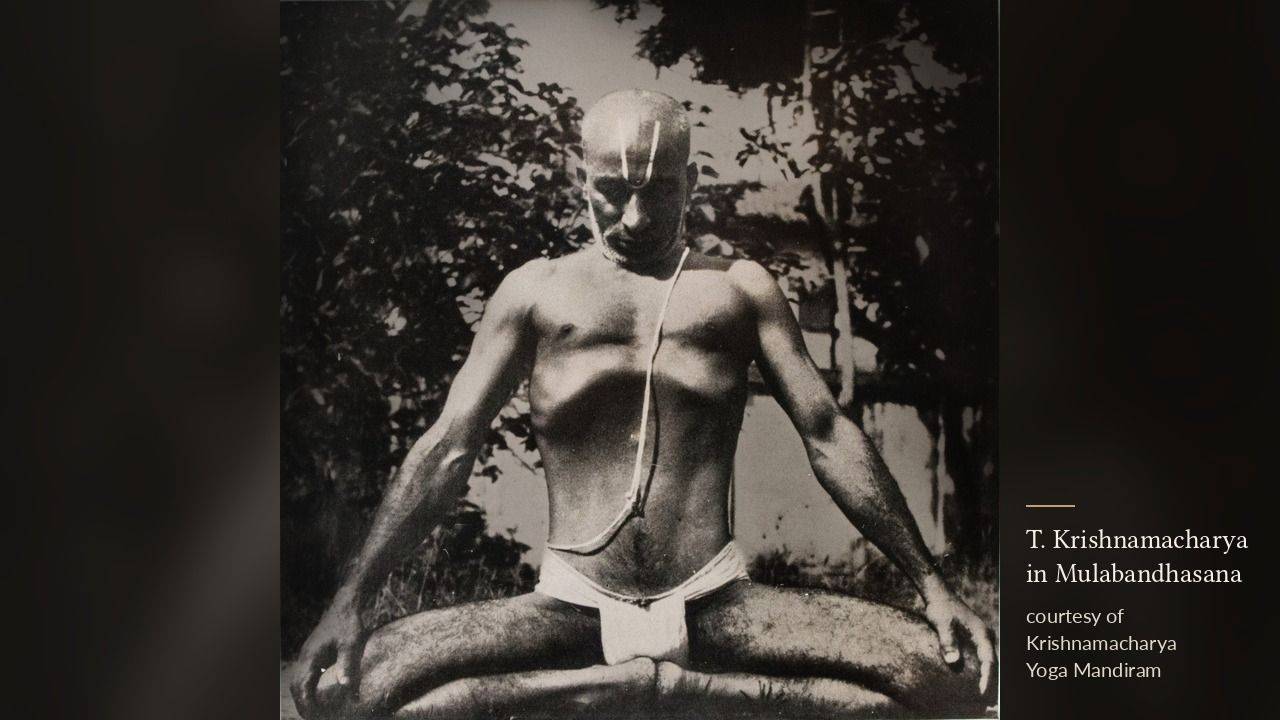
In a previous post, I compared two versions of three-part breathing: the familiar bottom-to-top sequence and the top-to-bottom approach I learned from T.K.V. Desikachar. I concluded that neither represents the natural way to breathe. Both are deliberately constructed exercises, and their usefulness depends on the individual and what they’re trying to accomplish.
I also suggested that Desikachar’s approach may promote greater kinesiological coherence among the diaphragm, rib cage, and abdominal wall. That argument has another important dimension, one that connects respiratory mechanics with a concept central to yoga practice for centuries: the bandhas.
From Breath Retention to Breath in Motion
In classical haṭha yoga, the bandhas were taught mainly in the context of breath retention, or kumbhaka. Krishnamacharya broadened their practical application by teaching bandha as the dynamic coordination of breath and movement.
In the teaching passed on through Desikachar, bandha was not limited to an action deliberately imposed during retention. It could also show up in the changing relationships of stability, mobility, and pressure regulation that support both breath and movement.
This understanding of bandha has been central to my teaching for decades. In Yoga Anatomy, I describe the coordinated action of three diaphragms: pelvic, respiratory, and vocal. Together, they help regulate pressure in the abdominal and thoracic cavities, contributing to the spinal support that lets us move safely while breathing smoothly. This isn’t simply a matter of contracting particular muscles. It’s a recognition that breath is the shape change of the body’s cavities, and that the spine is the back of those cavities.
Consider a slow, standing forward fold synchronized with exhalation. The weight of the torso places a mechanical demand on the spine and its supporting musculature. Coordinated respiratory and abdominal activity can help manage that demand, while glottal resistance (ujjayi) shapes the pressure relationships within the system.
In yogic terms, these relationships can contribute to sthira, the stability that allows movement without unnecessary strain. But stability is only half the equation. A functional system must also be capable of sukha: an easeful, spacious yielding of support when it’s no longer needed.
That interplay of support and yielding isn’t limited to movement. It also unfolds within a single breath, and that’s where the sequence of three-part breathing becomes significant.
How the Bandhas Support Top-to-Bottom Breathing
At the start of a top-to-bottom inhalation, the respiratory diaphragm contracts while the lower abdominal wall and pelvic diaphragm provide enough resistance to favor expansion of the rib cage. The glottis regulates airflow adding further resistance. The inhalation is then experienced, as Claude Maréchal writes in his article “Teachings,” “as a movement descending towards the epigastric region.”
That resistance matters because when the abdominal contents meet some resistance below, the dome’s descent is limited, and the diaphragm’s contraction is directed more toward lifting and widening the lower ribs. The abdominal wall isn’t opposing the diaphragm here. It’s giving it something to work against.
As the rib cage approaches its comfortable limit of expansion, that relationship can begin to change. The upper abdominal wall softens first, allowing movement into the epigastric region just below the sternum. As the breath continues, the region around and below the navel can yield to the extent the inhalation requires. The diaphragm’s action is then free to descend further, as the pelvic floor responds to the increasing pressure from above with a subtle yielding of its own.
This yielding is gradual, not a switch being turned off. Support isn’t established or abandoned at any particular moment in the breath. It’s progressively redistributed as the shape change shifts from the thorax to the abdomen. How much the lower abdomen and pelvic floor yield depends on the practitioner, the posture, and the purpose of the practice. Throughout, the glottis keeps the airflow smooth, so the transition is felt as one continuous inhalation. That’s in stark contrast to the bottom-to-top three-part breath, which is typically taught and experienced as a series of separate stages: belly, then ribs, then chest.
Why the Sequence Matters
That contrast isn’t just a matter of how the two techniques feel. It reflects a real difference in how each one organizes support.
In bottom-to-top breathing, the relationships associated with bandha must be reorganized partway through the breath, which is why the bottom-to-top sequence so often feels like distinct stages stitched together.
In Desikachar’s approach, the initial organization already includes the support that facilitates thoracic expansion. That support then gradually yields as abdominal movement becomes more prominent. Nothing has to be undone and rebuilt along the way.
Rather than imposing a series of shifting muscular constraints, the practitioner explores how the right balance of stability and mobility can unfold over a single inhalation. This is not a claim that Desikachar’s sequence is spontaneous, natural breathing. It remains a deliberately constructed technique. But, in my judgement, its organization cooperates more readily with the mechanics of diaphragmatic action and the dynamic function of the bandhas.
The Bandhas Aren’t the Goal Either
Making that case for one sequence brings a caution with it. It’s tempting to treat the bandhas as something we should always be doing correctly, just as it’s tempting to treat a particular breathing pattern as the correct way to breathe. But constant muscular engagement isn’t the same as functional stability. A system that can’t release support when it’s no longer needed isn’t necessarily more stable. It may simply be more rigidly attached to a habit.
As Desikachar writes in The Heart of Yoga:
Do not use bandhas throughout the entire asana practice. Like all other yoga techniques, bandhas should be practiced artfully and not obsessively.
and
Our yoga practice must always be a little more clever than our habits.
The value of bandha practice lies in developing the capacity to organize support appropriately as circumstances change. That’s why I find Krishnamacharya’s extension of bandha into breath and movement so significant. It frames stability not as a fixed muscular state, but as a dynamic relationship that continually adapts to the demands of movement.
It also helps explain why Desikachar’s breathing approach makes so much sense to me. The sequence isn’t simply about moving the chest before the abdomen. It’s an opportunity to experience how thoracic mobility, abdominal support, glottal resistance, and pelvic floor responsiveness can come into coordinated relationship.
Try It for Yourself
All of this comes down to one idea: the bandhas aren’t locks we apply and hold. They’re the body’s capacity to provide support where it’s needed and release it where it isn’t. Seen this way, the difference between the two sequences of three-part breathing isn’t about which one is correct. It’s about which one lets that capacity show up within a continuum of breaths. Top-to-bottom breathing establishes support first and lets it yield gradually. Bottom-to-top breathing gives support up early and then has to rebuild it. Neither is natural breathing, but they teach very different lessons about how stability and mobility relate.
You don’t have to take my word for any of this. The most reliable path to understanding it is to feel it for yourself.
Sit comfortably. Take a few easy breaths without trying to do anything in particular. Then try several rounds of bottom-to-top breathing: let the belly move first, then the ribs, then the upper chest. Notice where the breath seems to stall or change gears, and what you have to do to keep it going.
Rest for a few breaths. Then try top-to-bottom. Begin the inhalation by lifting the sternum, then widening the rib cage while the lower belly stays quietly supportive. Let the movement travel down toward the upper abdomen, and allow the lower belly to soften only as much as the breath asks for. If you’re familiar with ujjayi, add a gentle glottal resistance and notice how it changes the smoothness of the transition.
As you compare them, ask yourself:
- Where do you feel support, and when does it release?
- Does the breath feel like one continuous movement, or a series of steps?
- What happens in your pelvic floor, your back, and your throat?
Your answers count for more than anything I’ve written here.
Keep it easy. If you feel strain, lightheadedness, or effort building up, return to ordinary breathing. As Desikachar reminds us, these techniques should be practiced artfully, not obsessively. That applies to breathing sequences as much as to the bandhas themselves.
And it’s worth heeding the line that completes his caution: “The help of a good teacher is essential.”
If you have received value from my writing, please consider supporting it by subscribing to my online community. You will gain access to my online courses, monthly Q&A Zoom chats, and hundreds of hours of educational content.
Stay connected with news and updates
Join our mailing list to receive news and updates from Leslie.
Don't worry, your information will not be shared.
We hate SPAM. We will never sell your information, for any reason.