
Directional Flow in Breath Practice : Does the Order Matter?
Oct 27, 2026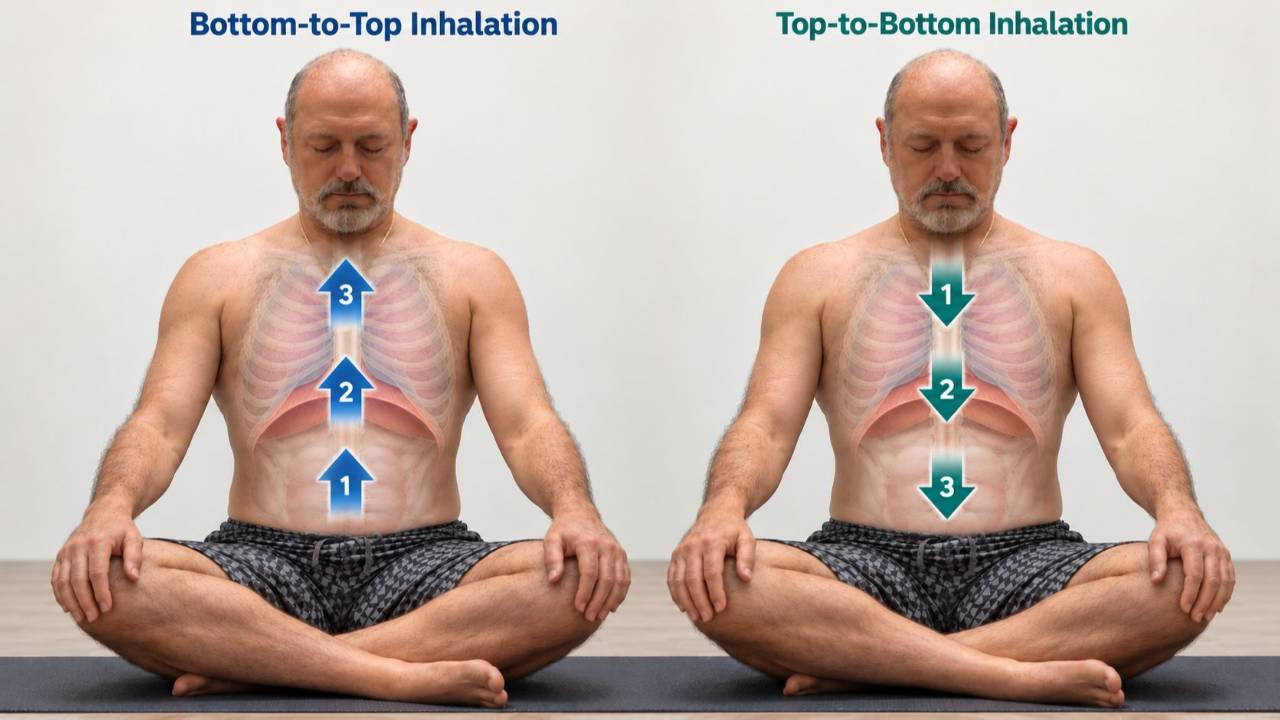
Back in November 2001, a question from the late yoga teacher Mukunda Stiles sparked a lively discussion on e-Sutra about the different ways yoga traditions taught three-part breathing. Some taught students to inhale from the bottom up, beginning with movement of the abdomen and progressing through the rib cage. Others, particularly in the tradition of Krishnamacharya and Desikachar, taught the reverse sequence. What began as a survey of teaching methods quickly evolved into a much broader examination of respiratory mechanics, anatomical misconceptions, and the difference between what we feel happening when we breathe and what is actually occurring.
I participated extensively in that discussion, challenging several assumptions that remain widespread in yoga teaching today. Among them were the idea that air fills the lungs from the bottom up, that visible abdominal movement is synonymous with diaphragmatic breathing, and that one particular breathing pattern is inherently more correct than another. Rereading the exchange exactly 25 years later, I’m struck by how many of the same questions persist, despite everything we’ve learned about respiratory physiology. The entire conversation is preserved in this 2001 thread, Breath Flow in Yoga Practice, and it provides a useful starting point for examining what actually happens when we practice three-part breathing.
In my previous post, promised to address something that has bothered me for a long time about the bottom-to-top version of three-part breathing: its rather awkward kinesiology. This sequence is often presented as a way to restore natural, complete breathing. But does it actually cooperate with the mechanics of the respiratory system? And how does it compare with the top-to-bottom sequence I learned from my teacher, T.K.V. Desikachar?
To answer those questions, we first need to consider what happens whenever we turn breathing into a technique.
The Moment We Divide the Breath, It Stops Being Natural
Breathing is an integrated physiological process. The diaphragm, rib cage, abdominal wall, pelvic floor, and other respiratory structures function together in a constantly changing relationship. Their relative contributions vary with posture, activity, metabolic demand, emotional state, training, and individual anatomy.
There is no single, universally correct distribution of movement between the chest and abdomen. A healthy respiratory system is capable of adapting to changing circumstances without requiring conscious instructions about which parts should move first.
As soon as we divide breathing into regions, stages, or prescribed sequences, we’ve introduced an artificial element. We’re no longer simply allowing breathing to happen; we’re deliberately organizing it according to a predetermined pattern.
The fact that many of us, in order to achieve breath resilience, learn the correct way to execute specific training methods does not mean that the methods themselves should be mistaken for a correct or natural way to be breathing all the time.
So, given that some "artificial" patterns are useful to learn in order to free up our system, a reasonable question could be: "are some patterns more natural than others?"
This might sound contradictory. If every prescribed sequence is artificial, how can one be more natural than another? The answer lies in looking kinesiological coherence.
The diaphragm doesn’t operate independently of the structures surrounding it. Its effects depend on the activity of, and coordination with, the other respiratory and postural muscles.
Some breathing sequences may cooperate more readily with those relationships than others, and any sequence might have legitimate uses for some people. But they aren’t all mechanically equivalent. Some are simply more awkward than others, and the gross, observable manifestation of a breath pattern does not tell you much about the degree or quality of muscular effort that goes into it.
A useful analogy
Here's an image I use for illustrating the different ways of achieving a "belly breath." Imagine you have a sandbag on a shelf, and you want it to end up resting on the floor. Think of the most efficient, least effortful way to achieve that goal. You could pick up the sandbag with both hands and throw it to the floor, adding effort and force to the equation. You could hold the bag gently in both hands and lower it to the floor, moving slowly or quickly. You could pick it up and simply drop it, letting gravity do the work for you. Or, you could avoid picking it up altogether, and just push it off the shelf.
Is it surprising that there are at least as many ways of getting your belly to bulge during an inhale as are there are ways of getting that sandbag onto the floor? In both cases, the end result can look the same, but the experience of achieving the result will be very different.
What’s Awkward About Bottom-to-Top Breathing?
Let’s begin with the familiar instruction to inhale into the belly while keeping the chest relatively still. The first problem is that the diaphragm doesn’t exclusively push the abdomen outward when it contracts. The diaphragm also wants to change the shape of the chest cavity as well, by lifting upwards at its lower attachments to the rib cage. So, if we’re instructed to make the abdomen move first while keeping the chest quiet, we need to restrict some of that thoracic movement...and we do this by engaging some of the musculature associated with...exhaling!
Now consider what happens next in the bottom-to-top sequence. Having begun inhalation with a relatively mobile abdominal wall and a relatively stabilized rib cage, the practitioner is instructed to shift toward lower rib cage expansion. This requires the practitioner to reverse a relationship between stability and mobility in the middle of an ongoing inhalation. In other words, you must undo the stabilization of the lower ribcage that enabled you to first move your abdomen in order to now mobilize your ribcage.
Finally, the instruction is to expand the upper chest. Depending on how this is taught, the practitioner may attempt to actively elevate the upper ribs, potentially recruiting additional inspiratory musculature to produce a movement that might have occurred more freely if the rib cage hadn’t been so restricted in the first place.
The result can be a rather elaborate muscular juggling act: first stabilize the rib cage while allowing the abdomen to move, then stabilize the abdomen while expanding the lower ribs, and finally produce additional upper thoracic movement toward the end of inhalation.
And, all of this happens as lung volume increases and the respiratory system encounters progressively greater elastic resistance.
Of course, not everyone performs the exercise this way. A loosely instructed sequence of attention may involve continuous overlap among the regions, without rigidly isolating their movements. But the more strictly the bottom-to-top sequence is enforced, the more apparent these mechanical complications become.
What Changes When We Reverse the Sequence?
The top-to-bottom inhalation I learned from Desikachar begins by allowing the rib cage to expand, followed by a progressive release of abdominal resistance as inhalation continues. The important word here is allowing because there’s an enormous difference between making a structure move through deliberate muscular effort and permitting it to move in response to forces generated elsewhere, and by elsewhere, I mean the diaphragm, which is our principal muscle of quiet inspiration.
In bottom-to-top breathing, we may begin with a relatively relaxed abdominal wall and subsequently introduce more resistance to emphasize thoracic expansion. In top-to-bottom breathing, we can begin with the abdominal support that facilitates thoracic expansion and progressively release that support as the breath continues.
Try a few rounds of the bottom-to-top, then the top-to-bottom breath and see if you notice the difference I'm describing.
One sequence may require us to introduce stabilization midway through inhalation. The other can begin with appropriate stabilization and progressively release it. This doesn’t establish that one technique always requires less muscular work than the other, but it does suggest that the top-to-bottom sequence can be more coherent with the changing mechanical relationships among the diaphragm, rib cage, and abdominal wall.
Also, in Desikachar's method, the directionality of the exhale is very specific. It moves from bottom-to-top. This has the advantage of following the directionality of the air as it leaves and enters the body.
Here's a diagram of that pathway. The arrow at the top pointing downwards represents the in-breath and the arrow at the bottom pointing upwards represents the out-breath.

Does That Make Top-to-Bottom Breathing Better?
Not necessarily. Imagine someone whose abdominal wall is habitually rigid, whose breathing involves very little abdominal displacement, and who has difficulty allowing the abdomen to move freely. For that person, practicing an abdominal-first inhalation might be an excellent way to explore an unfamiliar movement and discover unnecessary tension.
Now imagine someone who has spent decades being told to breathe exclusively into the belly while keeping the chest quiet. Their rib cage may have become unnecessarily restricted, and they may regard any upper chest movement as evidence that they’re breathing incorrectly. For that person, the top-to-bottom approach might be particularly valuable—not because it teaches a universally superior breathing pattern, but because it challenges the restrictions they’ve learned to impose.
In the final analysis, what we can definitively say is that the two sequences aren’t necessarily equivalent motor tasks. Their instructions create different relationships between stabilization and movement, and those differences deserve consideration. Most of all, the usefulness of either technique depends on the individual, their starting point, and what they are trying to accomplish.
The Technique Is Not the Goal
I began by arguing that no prescribed sequence of regional breathing movements can claim to represent "natural breathing." I want to end by returning to that point. The bottom-to-top sequence may be mechanically awkward, particularly when it reinforces unnecessary rib cage stabilization. Desikachar’s top-to-bottom approach may be more kinesiologically coherent.
But neither technique should become another rigid standard against which we judge everyone’s breathing. A technique can be useful without being mechanically optimal, and a mechanically coherent technique isn’t necessarily the most appropriate intervention for every person.
The question I find most useful isn’t whether someone can successfully reproduce a particular breathing pattern. It’s whether practicing that pattern helps them discover possibilities they didn’t previously have. Can they allow the rib cage to move without deliberately lifting it? Can they permit abdominal displacement without forcing the belly outward or downward? Can they experience stability without rigidity, and mobility without collapse? Can they recognize when muscular effort is necessary and when it’s simply getting in the way?
These are the kinds of discoveries that can make a breathing exercise worthwhile, regardless of its historical origins or the sequence it prescribes. There’s another dimension to this discussion that deserves its own exploration: Desikachar and Krishnamacharya’s approach to breathing was inseparable from thier understanding of the bandhas. Their unique understanding of the dynamic relationship of breathing to movement offers an additional perspective on why the order of a breathing sequence might matter. I’ll explore that connection in a future post.
If you have received value from my writing, please consider supporting it by subscribing to my online community. You will gain access to my online courses, monthly Q&A Zoom chats, and hundreds of hours of educational content.
Stay connected with news and updates
Join our mailing list to receive news and updates from Leslie.
Don't worry, your information will not be shared.
We hate SPAM. We will never sell your information, for any reason.