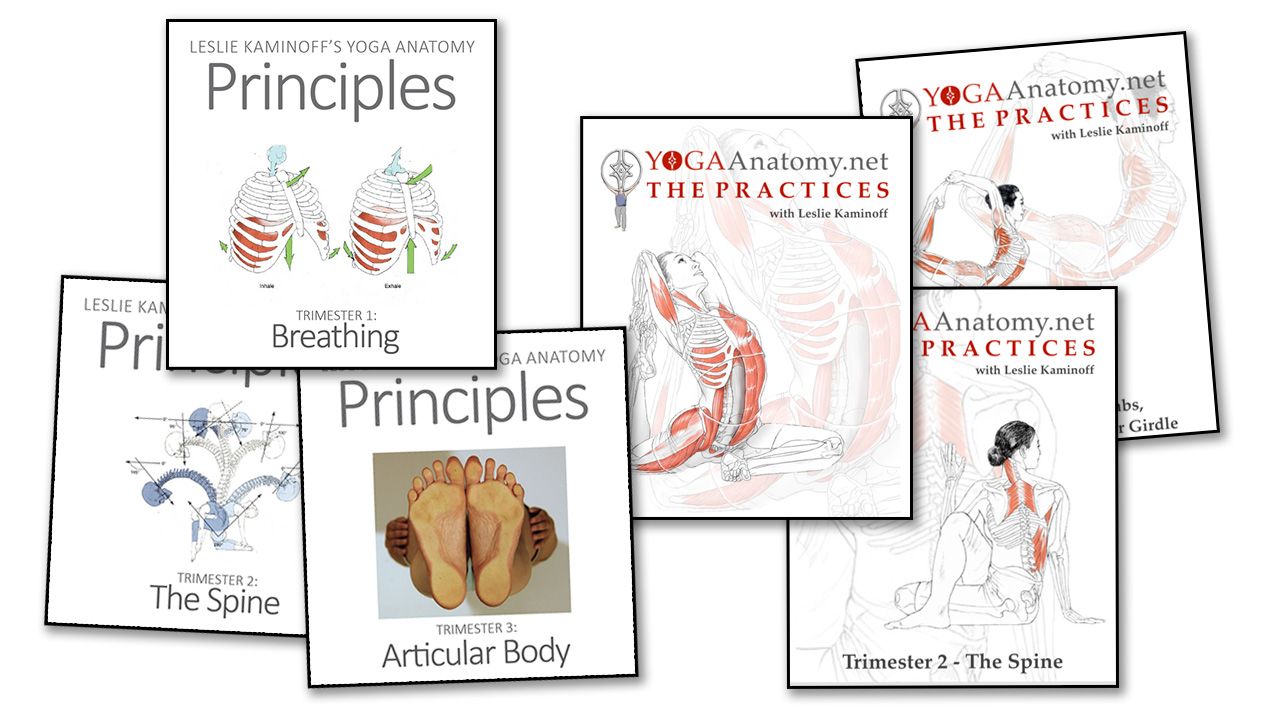
The Principles course is divided into three trimesters of 10 lessons each, plus loads of extra materials.
Trimester 1: Breathing
Tri 1, Lesson 1:
Introduction & Foundation
This opening trimester introduces Leslie's approach to integrating Western anatomy with the yoga teaching lineage of Krishnamacharya and his son Desikachar including:
- The Krishnamacharya lineage.
- Breathing as the integrating principle.
- Anatomy as storytelling.
- Leslie's personal journey.
- Simple concepts as lenses.
Tri 1, Lesson 2:
Prana & Apana
This trimester digs into the foundational concepts of prana and apana, grounding them in both ancient texts and biological reality including:
- Pranayama defined from ancient sources.
- The top-down breathing pattern.
- Apana moves in both directions.
- There is no single "right way" to breathe.
- Sukha, dukha, and the wheel.
Tri 1, Lesson 3:
The Most Powerful Breath You'll Ever Take
This Trimester shifts into physiology, using the story of the first breath as a gateway into deeper understanding of circulation, metabolism, and the body's inherited rhythms including:
- The first breath is the most powerful.
- Babies are poor breathing models.
- Two breathing myths debunked.
- The heart as rhythm-keeper, not pump.
- The brain and bone marrow as oxygen priorities.
Tri 1, Lesson 4:
Breath as Shape Change
This Trimester introduces the core anatomical framework for the rest of the course, built around a single defining idea about what breathing actually is including:
- Breathing is the shape change of the cavities.
- Air and breath are not the same thing.
- Leslie's breathing catastrophe.
- The diaphragm moves the rib cage.
- The universe fills the space we make.
Tri 1, Lesson 5:
The Engine of Shape Change: The Diaphragm Formula (SLARA)
The central thesis of the course is that breathing connects both yoga and anatomy. The Prana Nyasa chant taught at the start encapsulates this — prana (inhale/nourishment) and apana (exhale/release) are the foundational forces around which the entire teaching is organized.
- Breathing = shape change.
- The diaphragm is higher than you think.
- SLARA as a learning framework.
- The diaphragm spans nipples to navel.
- Strengthening requires space, not resistance.
Tri 1, Lesson 6:
Accessory Muscles: Steering Shape Change / Brmhana & Langhana
- The diaphragm is the engine; accessory muscles are the steering.
- "Increase" and "decrease" over "inhale" and "exhale."
- The ribcage slides, it doesn't accordion.
- Kapalabhati requires the diaphragm to step aside.
- Brmhana and Langhana as energetic guides.
Tri 1, Lesson 7:
The Pelvic Diaphragm
- Ujjayi creates structural support through valving.
- The pelvic floor has distinct layers with different functions.
- Mula bandha is deeper than the anal sphincter.
- The three diaphragms must coordinate.
- The teacher's core job is simple.
Tri 1, Lesson 8:
The Vocal Diaphragm
This Trimester explores the anatomy and mechanics of the vocal diaphragm, using the Sanskrit alphabet as a map of the human sound-producing system.
- Structure of the vocal diaphragm.
- Ujjayi as a variable valve.
- Pitch is produced by stretching, not shortening, the cords.
- The Sanskrit alphabet as phonetic anatomy.
- The voice as a diagnostic and therapeutic tool.
Tri 1, Lesson 9:
Intrinsic Equilibrium / Structural Prana
This Trimester introduces the concept of intrinsic equilibrium — built-in postural and energetic forces present in the body's structure — and connects it to a key sutra about how profound change actually occurs.
- Three zones of pressure create a natural upward force.
- The ribcage, spine, and pelvis are spring-loaded.
- Good posture is an undoing, not an effort.
- The Farmer Parable (Yoga Sutra IV.3).
- Practice as channel-digging, not water-carrying.
Tri 1, Lesson 10:
Mahamudra / Anatomy of the Central Channel
The final Trimester of the trimester brings together breath, bandha, and yogic philosophy through the practice of mahamudra and Krishnamacharya's distinctive view of kundalini.
- Surrender is an act of will.
- Mahamudra forces breath to go deep.
- Shushumna as a kinesiological concept.
- Kundalini as obstruction, not dormant energy.
- The fireplace as internal ritual.
Trimester 2: The Spine
Tri 2, Lesson 1:
A Brief History of the Spine
This Trimester traces the evolutionary and developmental origins of the spine, using the yogic concepts of sthira (stability) and sukha (mobility) as a guiding framework.
- The spine as nature's solution to a balancing act.
- Primary and secondary curves reflect evolutionary history.
- Individual development mirrors evolutionary history.
- Respecting the curves matters for yoga teaching.
Tri 2, Lesson 2:
Overall Architecture of the Spine — Form and Function, Compression and Tension
Using suspension bridge engineering as a central metaphor, this Trimester examines how the spine manages the forces of compression and tension, and challenges the dominant cultural narrative around disc herniation and back pain.
- The spine has two complementary columns.
- Discs function like the dampers in earthquake-resistant bridges.
- Disc findings on MRIs are poorly correlated with pain.
- Dr. John Sarno's work points to emotional suppression as a key pain driver.
Tri 2, Lesson 3:
The Five Motions of the Spine — Ranges of Motion
This Trimester maps out the five spinal movements — flexion, extension, lateral flexion, axial rotation, and axial extension — exploring how vertebral shape governs what the spine can and cannot do, and interrogating common yoga alignment cues.
- The spine's range of motion is dictated by vertebral architecture.
- The lumbar spine barely rotates — and that's by design.
- "Forward bending" and "back bending" are imprecise terms.
- Axial extension is not the same as neutral spine.
- Healthy spinal movement is well-distributed movement.
Tri 2, Lesson 4:
Stretching the West — Forward Bending / Spinal Flexion / The Back Line
This Trimester explores paschimottanasana (seated forward fold) through an anatomical and functional lens, challenging common alignment assumptions.
- "Healthy movement is well-distributed movement."
- Paschima means the whole back surface, not just the hamstrings.
- Form should serve function, not the other way around.
- The nervous system, not just the muscles, governs range of motion.
- Breathing in the shape redirects prana and mobilizes the thoracic spine.
Tri 2, Lesson 5:
Breath-Centered Backbending — Spinal Extension Explorations
This Trimester examines spinal extension and backbending through the lens of breath mechanics, myofascial anatomy, and well-distributed movement, using bridge pose, wheel, and bow as primary vehicles.
- Extension is far less evenly distributed in the spine than flexion.
- The T10–T12 hinge is real and easily overused.
- Breath mechanics determine whether a backbend is well-distributed or compressed.
- In wheel pose, the legs are more important than the arms.
- "Lengthening the east" (purvottanasana) is a sensory goal, not a spatial one.
Tri 2, Lesson 6:
Twist and Bend, But Don't Break — Lateral Flexion & Axial Rotation
This Trimester explores how the spine bends and twists, with a focus on understanding where movement actually originates versus where we assume it comes from.
- The lumbar spine barely rotates.
- Lateral flexion and moving laterally in space are different things.
- Twisting from the inside out, not the outside in.
- Healthy movement is well-distributed movement.
- What feels like lumbar twisting isn't.
Tri 2, Lesson 7:
Where to Stick the Yoga Stick — Axial Extension
This Trimester completes the series on spinal movement by examining axial extension — the lengthening or "tallening" of the spine — and questioning how it is commonly overused in yoga instruction.
- Axial extension and neutral spine are not the same thing.
- The obsession with "lengthening the spine" can cause harm.
- Axial extension is produced by the same muscles used in breathing.
- The body is inherently "neutral-seeking."
- Axial extension is a useful place to visit, not to live.
Tri 2, Lesson 8:
Symmetry vs. Balance — Scoliosis, Osteoporosis
The central argument is that symmetry and balance are fundamentally different things.
- Asymmetry is universal and structural.
- Scoliosis is a spectrum, not a binary.
- Yoga practice for scoliosis is about finding your asymmetry, not correcting it.
- Osteoporosis requires nuanced risk/benefit thinking.
Tri 2, Lesson 9:
The Iliopsoas Complex: The Psoas as a Sensory Organ
This Trimester focuses on the psoas muscle, with guest Amy Matthews joining for part of the session.
- The psoas as sensory organ, not just a mover.
- Three-dimensional path through the body.
- True psoas stretching requires lumbar flexion, not extension.
- The psoas minor and pelvis-spine relationship.
- The psoas as part of the Deep Front Line.
Tri 2, Lesson 10:
The Central and Autonomic Nervous System: Theory & Practice
This session is largely led by Amy Matthews, with Leslie facilitating. It challenges many common yoga-world assumptions about how the nervous system works.
- Naming is not the same as knowing.
- Sensory input and motor response are distinct from interpretation.
- Sympathetic does not mean "fight or flight."
- Sympathetic and parasympathetic are both active; they are not opposites.
- Yoga cannot reliably produce a prescribed feeling in a group.
Trimester 3: Articular Body
Tri 3, Lesson 1:
A Brief History of the Limbs — Evolution and Development of the Extremities
This class explores how human limbs evolved and what their structure reveals about how we should use them in yoga practice.
- Upper vs. lower extremity: sthira vs. sukha.
- The hand evolved for manipulation, not locomotion.
- Hands and feet are proportionally inverse.
- Embryological development mirrors evolution.
- Learn to stand on your feet before standing on your hands.
Tri 3, Lesson 2:
Balance & Equilibrium — BOS, COG, ROM
This class establishes a clear framework for understanding balance in the body, with practical implications for how asana should be taught and sequenced.
- Base of support (BOS) is the foundation of everything.
- Center of gravity (COG) must stay over the base.
- Perception powerfully shapes the experience of balance.
- A single, integrated center of gravity is required for stable poses.
- BOS → COG → ROM is a hierarchy, not a checklist.
Tri 3, Lesson 1:
A Brief History of the Limbs — Evolution and Development of the Extremities
This class explores how human limbs evolved and what their structure reveals about how we should use them in yoga practice.
- Upper vs. lower extremity: sthira vs. sukha.
- The hand evolved for manipulation, not locomotion.
- Hand and foot are proportionally inverse.
- Embryological development mirrors evolution.
- Learn to stand on your feet before standing on your hands.
Tri 3, Lesson 2:
Balance & Equilibrium — BOS, COG, ROM
This class establishes a clear framework for understanding balance in the body, with practical implications for how asana should be taught and sequenced.
- Base of support (BOS) is the foundation of everything.
- Center of gravity (COG) must stay over the base.
- Perception powerfully shapes the experience of balance.
- A single, integrated center of gravity is required for stable poses.
- BOS → COG → ROM is a hierarchy, not a checklist.
Tri 3, Lesson 3:
The Yoga of the Foot – Foundations of Standing
- The foot is an evolutionary all-terrain vehicle.
- The foot is a tripod, not a four-point structure.
- Weight travels through the foot in a spiral pathway.
- Plantar fasciitis and heel spurs stem from muscular weakness.
- Proprioception is the missing link in foot health.
Amy Matthews Guest Appearance –
Foot Musculature
- Intrinsic muscles deserve more attention than they typically receive.
- The foot has extraordinary articulation potential — matching the hand.
- Intrinsic muscles allow the foot to operate independently of the ankle.
- The lumbricals perform a unique dual action.
- Small movements in the foot have whole-body consequences.
Tri 3, Lesson 4:
Human Gait — The Yoga of Walking
This class focuses on how the anatomy of the foot and lower leg connects to healthy walking mechanics, with hands-on demos throughout.
- Intrinsic vs. extrinsic foot muscles
- The soleus is often neglected
- The falling step vs. the foot-swing step
- The leg swing originates at the psoas
- Weight spirals through three points of the foot
Tri 3, Lesson 5:
Yoga and the Knee — Sthira and Sukha in the Body's Largest Joint
This class dives deep into knee anatomy, injury mechanics, and clinical assessment, anchored by Leslie sharing footage of his own arthroscopic surgery.
- The knee is not a hinge joint
- The menisci are critical and vulnerable
- How to protect the meniscus in yoga
- Articular cartilage is avascular and heals poorly
- Knee pain deserves respect, not rationalization
Tri 3, Lesson 6: The Articulate Pelvis – The Hip Joint and Pelvic Articulations
- The hip joint is a true ball-and-socket joint
- "Hip openers" is anatomically misleading
- "Tuck your tail" refers to three distinct movements
- "Yoga butt" is inflammation traveling through the sacrotuberous ligament into the hamstrings, often mistaken for sciatica.
- Healthy movement is well-distributed movement.
Tri 3, Lesson 7:
The Shoulder Girdle – Articulations, Relations, Actions
- The shoulder involves four joints, not one: the glenohumeral, acromioclavicular (AC), sternoclavicular, and scapulo-thoracic.
- The sternoclavicular joint is the only bone-to-bone connection between the arm and the axial skeleton.
- The shoulder trades stability for mobility compared to the hip.
- Adhesive capsulitis (frozen shoulder) occurs when the joint capsule becomes scarred and restricted.
- Arm movement should initiate from the axial body
Tri 3, Lesson 8:
The Warrior Series — A Hands-Free Practice
This class centers on a standing vinyasa sequence that avoids upper-body weight bearing, emphasizing leg strength and spinal mobility through breath.
- The hands-free design is intentional and therapeutic.
- A stable base enables a free upper body.
- Spinal spiraling, not segmental alignment cues, drives the postures.
- Doing one side completely before switching is deliberate.
- Sequencing is about principles, not choreography.
Tri 3, Lesson 9:
Arm Support Strategies — Pathways of Weight
Amy presents a detailed anatomical and experiential framework for understanding how weight travels through the arms to the spine, challenging common shoulder cues in yoga.
- Weight travels through bones along a specific pathway.
- The shoulder joint's integrity is not dependent on scapular position.
- "Pull your shoulders down your back" is counterproductive.
- Superficial muscles (lats, pecs) are movers, not organizers.
- Stability means clarity of relationship, not immobility.
Tri 3, Lesson 10:
Headstand – Vinyasa Krama in the Theory and Practice of Inversions
This final class of the trimester uses headstand as a model for vinyasa krama — the step-by-step science of sequencing — to explore how complex poses can be broken into learnable, individual skills.
Key Points:
- Headstand as a skill-set, not a goal.
- Three "gateway" practices.
- Individual anatomy matters enormously.
- Rooting down enables lifting up.
- Breath integration is the foundation.
Ready to go further? Select one of the offers below to join the community.

CONTACT FORM: