Pain, Maps, and Meaning: Part 4 - The Indivisible Patient
Jul 05, 2026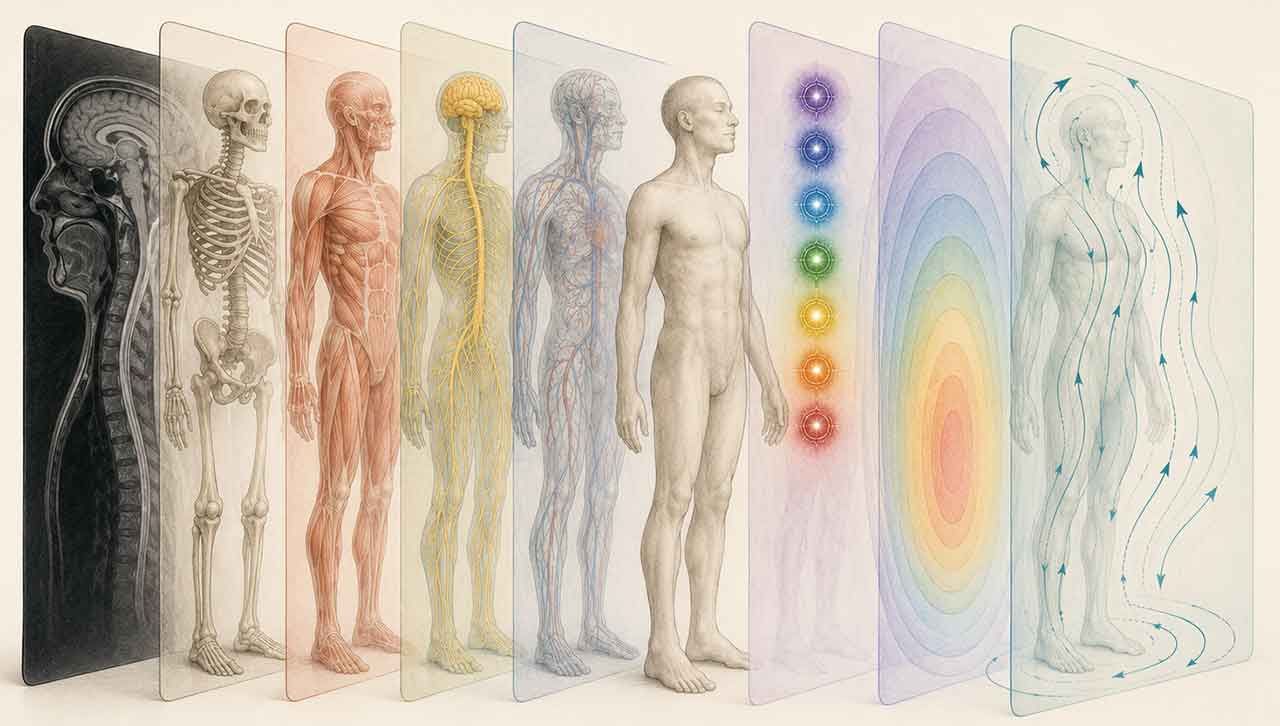
The first three parts of this series examined the maps we use to understand pain. Imaging is a map. Anatomy is a map. Psychology is a map. Pain neuroscience is a map. Each reveals something important, but one of them is the actual territory - the patient.
That distinction may seem obvious, but it can be too easy to forget in practice. Every clinician, including every yoga educator, brings maps into the room. We can’t function without them. The real question isn’t whether we have maps. It’s whether we remember that we’re using them. That insight leads me back to a question I’ve been exploring through anatomy, yoga, and philosophy for much of my adult life.
What do we actually mean when we say my body?
That phrase appears so ordinary that it hardly attracts attention. Yet if we focus on it for a moment, an interesting question appears. Who—or what—is the “my”?
I’ve spent some time in cadaver labs where, by definition, I get to see a body without consciousness. The “my” that was connected to it is gone. Now reverse the proposition. Where on this earth would I go to see a “my” without a body?
My point here is that I’ve developed a habit of asking what my concepts actually refer to before I build theories upon them. That habit has influenced the way I think about every explanatory model I’ve encountered, whether their referent is anatomical, physiological, behavioral, experiential, or functional. The important question isn’t whether a map is useful. It’s what aspect of reality is actually being mapped.
Every attempt to understand begins with an act of division. Language divides experience into words. Concepts divide the world into categories. Maps divide territory into features worth noticing while leaving others in the background. Models simplify complexity so that we can ask useful questions.
Anatomy does the same thing. The word itself means “to cut up.” Dissection has taught us more about the human body than almost any other method of inquiry by revealing relationships that in life are never encountered in isolation.
Yoga is no exception. It offers its own maps: koshas, chakras, nadis, vayus, and many others. I’ve found these maps enormously valuable, not because they reveal different structures hidden inside us, but because they offer different ways of examining a person’s living experience. Like every map, they illuminate certain features while leaving others outside the frame.
Pain introduces another kind of division. People living with persistent pain often describe feeling alienated from themselves. Their language reflects it. “My body has betrayed me.” “My back gives out on me.” “My shoulder won’t let me.” Whether those experiences arise from injury, fear, habit, trauma, or years of unsuccessful treatment, the sense of fragmentation is real. The experience deserves to be taken seriously without assuming that it reveals the fundamental nature of the person.
These considerations change the clinical encounter. If I begin by assuming that one map explains the patient, I’ve already narrowed my field of vision. Every observation I make is then likely to reinforce the map I arrived with.
Structural practitioners tend to find structural problems. That is why Dr. John Sarno spent many frustrating decades trying to convince his fellow physicians that a patient’s emotional life had a great deal to do with their physical pain. Many of the psychologists who collaborated with Sarno experienced a parallel frustration as they tried to convince their own colleagues that a patient’s physical embodiment had something to do with their emotional life. Scope-of-practice boundaries often prevented them from touching their patients and, in some psychoanalytic traditions, even from observing the body at all. Traditional Freudians, for example, typically sit with their backs to their patients.
Yoga educators occupy a somewhat unusual position because our discipline developed outside the professional silos of specialization that shape modern healthcare. We are free to observe breathing, posture, movement, attention, emotion, behavior, and lived experience within the same encounter. That doesn’t make yoga’s maps more complete than anyone else’s. It simply means we have more than one map available at a time, while remaining just as vulnerable to mistaking any of them for the territory.
The longer I’ve worked with people in pain, the less interested I’ve become in deciding which map is correct. That question still matters, but not nearly as much as I once thought.
A more useful question is whether the map I’m using is helping me understand the person in front of me, or if it's simply confirming what I expected to find.
Steve Kerr’s story points in the same direction, and over the years I’ve witnessed similar turning points in many of my own students and clients, as well as in my own struggles with pain. The details are always different, but a common thread runs through them. Healing often begins when one map loses its monopoly on the story, allowing the person—not the explanation—to return to the center of the inquiry.
The first three parts of this series questioned whether our explanations of pain correspond to reality. This final installment has asked whether there is a more fundamental division embedded within those explanations, and whether it belongs to the patient at all—or primarily to the maps we use to understand the patient.
At the beginning of this essay, I asked, “Where on this earth do we encounter a ‘my’ without a body?” I don’t intend to answer that here because I think it’s a question worth holding onto. What I am prepared to say is this:
The method is the map.
The patient is the territory.
The patient is indivisible.
If you have received value from my writing, please consider supporting it by subscribing to my online community. You will gain access to my online courses, monthly Q&A Zoom chats, and hundreds of hours of educational content.
Stay connected with news and updates
Join our mailing list to receive news and updates from Leslie.
Don't worry, your information will not be shared.
We hate SPAM. We will never sell your information, for any reason.